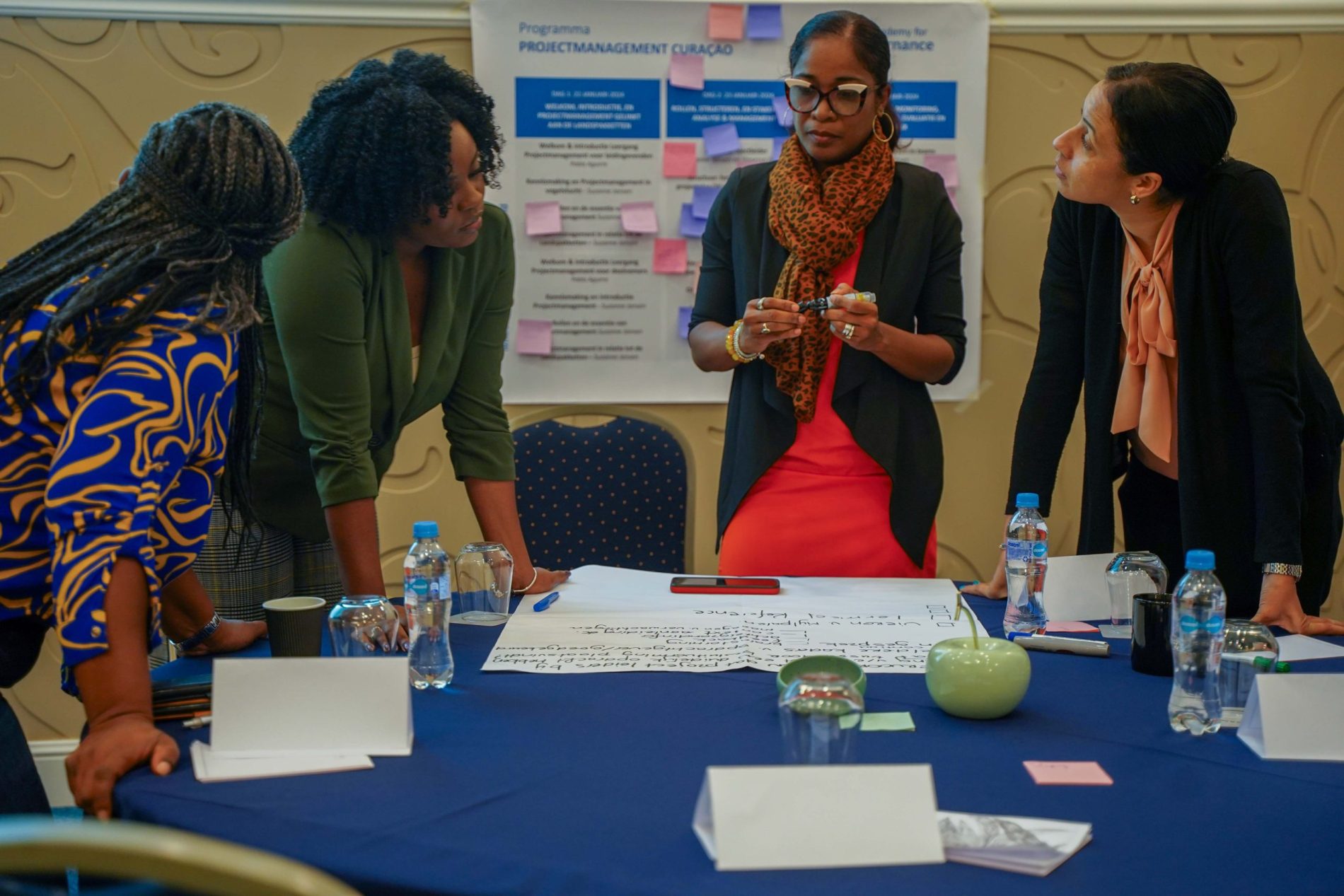
Effecting change in the public sector is complex. Projects take place in dynamic political environments, where priorities shift, decision-making can be slow, and roles and responsibilities are not always clearly defined. At the same time, project managers must work with limited resources, coordinate across multiple institutions, and engage a wide range of stakeholders with different interests.
Government projects often fail or get delayed because of political interference, lack of coordination or clear role distribution or a lack of knowledge or management skills. As a result, project managers face many challenges. They often work with limited resources, must coordinate between multiple institutions, and engage a wide range of stakeholders with different and sometimes conflictintg interests. This calls for a structured yet flexible approach to project management tailored to the public sector.
In this course, we combine practical tools with hands-on insights into how projects actually function in the public sector. Participants bring a project from their daily work and use it to apply tools and reflect on their current project management practices. They learn how to apply different project management tools in a way that fits their organisational reality, helping them translate plans into concrete and achievable results.
This course provides a practical introduction to project management in public sector contexts. Participants explore the full project cycle, from defining objectives and structuring projects to stakeholder engagement, implementation and monitoring.
A central element is the “I – WE – THEY – IT” approach, which helps participants manage projects from four complementary perspectives:
Participants work with practical tools such as Work Breakdown Structures, stakeholder analysis, risk management and monitoring methods. The course also creates space to critically reflect on existing project management practices and structures within their organisations.

This course is relevant for professionals involved in public sector reforms, in particular designing, managing or supporting projects in all policy fields, from introducing social security schemes to climate adaptation measures to new taxation tools and urban renovation. This includes project managers, programme managers and policy advisors.
It is particularly suitable for staff working in government institutions at national, regional or local level, as well as professionals from donor organisations, NGOs and development agencies who are involved in implementing public sector projects in complex and multi-stakeholder environments.
After this course, participants will receive a professional certificate of completion from The Hague Academy for Local Governance.
*Professionals working in local government or for local NGOs on the DAC list of ODA-recipient countries (OECD) may qualify for a reduced course fee. Contact us for details.
This course will help you:
After this course, you will receive a professional certificate of completion from The Hague Academy for Local Governance.
Experts who are involved in this course:
In a world of growing complexity, where government organisations face a variety of challenges, a strong project management approach is more critical than ever. Project management excellence depends on effective team coordination, setting clear, achievable goals, and proactively managing risks.
Throughout the course, participants work on a project from their daily work, applying concepts and tools such as stakeholder analysis, project planning and risk management directly in their own context. The programme creates space to critically reflect on current projects, project management practices and organisational structures, and to identify what works and what can be improved.
The course includes role plays, group assignments and facilitated discussions that reflect common challenges in public sector project management, such as working across institutions, dealing with competing interests and managing limited resources. Participants learn from each other’s experiences and from lessons learned from The Netherlands, and explore practical strategies to overcome challenges and obstacles.
In addition, a practising public sector project manager from the Netherlands shares real-life examples and lessons learned, linking theory to day-to-day practice.
This combination of expert input, peer learning and practical application equips participants with the skills and confidence to manage projects more effectively in their own organisational context.
Find the practical information for the course here.
After submitting your completed application, you will receive a confirmation of receipt. Once we have assessed your application and admitted you to the course, we will send you an invoice with payment details.
Payments can be made by bank transfer or by PayPal request. We offer the option of paying in one or two instalments. An advance payment of 50% secures the reservation of a seat at the training until the payment deadline, one week prior to the course start date. Your participation in the course is guaranteed only after receipt of full payment.
Please note that The Hague Academy accepts registrations on a first-paid, first-served policy.
Some countries require a visa to enter the Netherlands. Please check with The Netherlands or the embassy for the visa requirements related to your country. Because of the length of time needed for the visa procedure, we advise you to start this process as soon as possible. Once we have received your payment for the course, The Hague Academy will send you an acceptance letter which will assist you in arranging your visa to The Netherlands.
We understand that unforeseen circumstances may arise, necessitating the cancellation of your attendance. In such cases, please be aware of our cancellation policy:
The Hague Academy for Local Governance reserves the right to cancel a course if the number of participants is insufficient or due to any other unforeseen circumstances. In this case, your payment will be 100% reimbursed. Other costs such as transportation or hotel cannot be reimbursed.
At the Hague Academy, we specialise in developing training programmes that fit your specific needs. Contact us if you are interested in a customised training!