How to include the voices of all citizens in the policy process.

An increasing number of countries are experiencing democratic decline, political polarisation, decrease in trust in public institutions, and shrinking space for citizen participation as reported in the 2026 Democracy report by the V-Dem institute. A recent OECD-survey on Drivers of Trust in Public Institutions reports that while trust in public institutions varies a lot per country, citizens tend to trust less in national governments than in local governments and civil service. At the same time, many citizens, politicians, and scientists are joining forces worldwide to defend their democracies, by fighting for citizen rights, press freedom and digital autonomy as well as practicing innovative ideas for increased citizen participation. One of these innovative approaches are citizens’ assemblies.

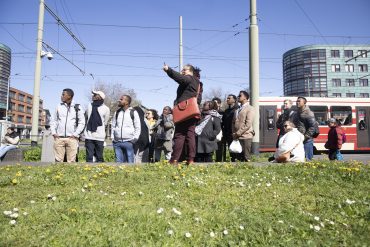
Citizens’ Assembly in Heerlen, The Netherlands. Photo credits: Sirella Dieteren
The Benefits of Citizens’ Assemblies
To include citizens’ voices more in government policies, countries across the world experiment with citizens’ assemblies. These assemblies consist of citizens from the community chosen by lottery and invited to take part in public discussions to inform policy decisions. The concept, practiced already in ancient Greece, was revived by the Belgian author David van Reybrouck* as a way to ‘democratise democracy’. By exchanging views and listening to the concerns and ideas of citizens, citizens’ assemblies can strengthen democracy, overcome differences, and prevent polarisation.
Tess Schijvenaars, expert in our course on Citizen Participation, explains that organising a citizen assembly is not as easy as it may sound. It requires careful preparation. Governments need to communicate clearly about the reasons for citizens’ assemblies and explain what they will do with the recommendations to manage expectations of citizens. Furthermore, they need to be transparent about the criteria for selection of the participants.
The advantages of citizen assemblies are clear: since they gather a representative sample of the community, considering neighbourhood, age, gender etc., they allow people who are seldomly represented in traditional political processes to contribute. This brings in new perspectives and therefore improves the quality of decision-making. Moreover, citizen assemblies can (re)-build trust by showing that citizen input is taken seriously.
“Participation in citizens’ assemblies can enhance citizens’ sense of democratic efficacy: citizens come to recognise that their voice, concerns, needs and perspectives matter, and that they are able to play a meaningful role in democratic decision-making. Some evaluations indicate that participants of citizens’ assemblies report higher levels of trust in local democratic institutions after taking part.”
Tess Schijvenaars, advisor at EMMA and expert in the Citizen Participation and Inclusive Governance course

Participants discussing during the deliberation session of the 2025 National Citizens’ Assembly on Climate policy in the Netherlands.
Citizens’ Assemblies in Practice: Cases from The Netherlands, The Gambia, and Armenia
In the course, Tess presents examples from countries in different parts of the world. In the Netherlands, citizens’ assemblies are often organised at the local level to discuss issues such as climate policy, urban development, or the energy transition. The country’s first National Citizens’ Assembly on climate policy took place in 2025. As a result, the government has pledged to implement 41 of the over 80 recommendations made within the categories of food, products, and travel. Adopted recommendations include cutting food waste by 50% by 2035, making healthy food more accessible, a sustainability label for products, the “right to repair” to make electronics last longer, and improving national and international train connections.

Infographic made for the National Citizen’s Assembly on Climate in 2025. Credits: Nationaal Burgerberaad Klimaat
- In Armenia, the “Convention of the Future Armenian” was also the country’s first national citizens’ assembly. Held in 2023, it aimed to create a new citizen-led deliberative process for enabling Armenians to improve their ability to collectively address the challenges they face by 2041. It brought together 200 citizens living in Armenia and in the diaspora for three days of deliberation, which resulted in 40 recommendations for the government. The recommended initiatives included an online coordination council of the Armenian Genocide recognition process, the creation of “Artsakh” Foundation for Development Projects, which will finance projects that advance the economy and security in Artsakh, the compiling of a list of all Armenian cultural heritage artefacts, and the creation of an immigration organisation and advocacy agency.
Watch a video about Armenia’s first national citizens’ assembly here: https://www.youtube.com/watch?v=41QVJiMLIgo
- In the district of Kerewan, The Gambia, last year the national citizens’ assembly on climate change for the The Great Green Wall initiative invited citizens of all ages, genders, and socio-economic backgrounds to discuss potential measures against desertification. Over four days, thirty people from over twenty villages across the North Bank Region, farmers, teachers, small business owners, and students, aged from eighteen to sixty-six, gathered to share their experiences. All recommendations were consolidated into the initiative: “Enhancing Community Resilience to Climate Change through Sustainable Practices”, which encompasses community-led environmental monitoring, carbon financing via reforestation, and mangrove restoration, renewable energy promotion, environmental regulation enforcement, and grassroots climate education. The Assembly emphasised establishing governance structures involving local authorities, community organisations, district coordinators, government institutions, and development partners for effective implementation and sustainability.
Watch a video about Kerewan’s citizens’s assembly here: https://www.youtube.com/watch?v=3-7A2Ty9z0Y
In conclusion: Despite democractic decline, innovative forms of engagement can strengthen trust
In the face of declining trust in public institutions and polarisation, (local) governments recognise the importance of citizen engagement. If set up correctly, citizens’ assemblies can be an innovative practice for increasing trust in public institutions among participants and including citizens in informing policy making. Learn more about how you can implement innovative approaches to citizen participation in your work in our upcoming course on Citizen Participation and Inclusive Governance.
*Learn more about Van Reybrouck’s theory here: https://www.youtube.com/watch?v=KS9EMvbBq_U
Related courses
We offer a diversity of courses throughout the year. Here are several other courses you might like.