How to build climate resilience and improve local response mechanisms of local authorities.

The Sustainable Development Goals (SDGs) are a universal call to action to end poverty, protect the planet and ensure that all people live in peace and prosperity. Local governments play a special role in implementing the SDGs, because problems are best solved at the level closest to the people affected. In the Netherlands, municipalities, together with their citizens, are adapting the SDGs to their local context, focusing on sustainability, climate adaptation, and social inclusion.
The Dutch city of Leiden has implemented an interactive mobile game Global Goals Go, through which citizens can discover initiatives and projects that relate to the SDGs.

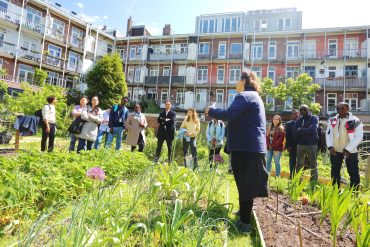
Participants of the Inclusive Service Delivery and the SDGs course 2025 play Global Goals Go in Leiden.
“The Global Goals only come alive through citizens, because real change starts when people recognize these universal truths in their own lives and act on them.” Linda Smit, founder of Global Goals Go
How municipalities and their citizens can move from awareness to action
The Sustainable Development Goals (SDGs) make the connection between the global and local context visible. While they apply globally as part of the agenda for a better world by 2030, many of the goals are realised locally: in cities, towns, and neighborhoods. Municipalities therefore play a key role.
One challenge is that many people are still unfamiliar with the SDGs or perceive them as abstract and distant. That is why awareness is essential: only when people understand what the goals mean for their own living environment they will support SDG-actions.
With the knowledge of local initiatives, citizens can take action
Global Goals Go is an outdoor climate challenge designed to be played together: by schools, neighbourhoods, companies, families, and municipalities. For municipalities, the game offers a unique way to raise awareness about the SDGs and to make sustainability tangible to its citizens.

Guided by expert Ant Brandenburg, participants of our course on Inclusive Service Delivery & the SDGs moved through the city of Leiden and visited places where the SDGs are made visible. One of the stops is the Canal Watch House, along the canals of Leiden.
Originally used to operate the bridge, the house contains an exhibition of special finds from in and around the canal. The volunteers of De Grachtwacht (the canal watch) conduct research into urban nature and the impact of plastic on aquatic environments. During their clean-up activities, they collect waste and gather valuable data to better understand plastic pollution, contributing to SDG 14: Life Below Water.
“Only when people see how these global goals connect to their own lives, and to those of others, they can take action. Municipalities are the key, since they translate the Global Goals into action, empower citizens and make the progress visible.” Linda Smit, founder of Global Goals Go
Municipalities as catalysts of change
By using the SDGs as guiding principles, municipalities can link policy to the daily lives of residents, encourage collaboration, and create tangible impact. Global Goals Go shows that the SDGs do not need to remain abstract but can become concre in the streets and neighborhoods of towns and cities.
The game Global Goals Go is already available in various locations in the Netherlands, such as Leiden, but can be set up in any municipality.
Would you like to experience how Dutch municipalities bring the SDGs closer to their communities? Our open courses and customised trainings discuss the Global Goals Go game and many other best practices from around the world. For more information, see our Inclusive Service Delivery and the SDGs, Citizen Participation and Inclusive Governance and Local Climate Response courses.
This article was co-written by Linda Smit, founder of Global Goals Go and The Hague Academy.

Related courses
We offer a diversity of courses throughout the year. Here are several other courses you might like.