How to build climate resilience and improve local response mechanisms of local authorities.

Urban resilience is often seen only through the lens of preparing cities for the ecological challenges posed by climate change, but resilience is most effective when social and economic perspectives are equally considered. Climate adaptation, poverty reduction, gender equity, and local economic development often overlap in practice, even if addressed separately in policy.

Strengthening Urban Resilience

Forbes Davidson is an urban planning, management, and policy expert with global experience in capacity development for sustainable cities. As an expert, he regularly collaborates to our courses on urban resilience and supports participants who work on policies and projects related to economic and social resilience.
Forbes likens the importance of the economic and social dimensions in urban resilience to cloth weaving: the more tightly woven the threads, the harder it is to tear.
Whether they are expected or unexpected, cities must respond to shocks and stresses. For practitioners, the task is therefore to nurture both the social and economic dimensions that strengthen urban resilience.
The Social Dimension
Social resilience includes the city’s ability to address issues like underemployment, inadequate housing, limited access to education, and chronic violence.
Strong local institutions and citizen engagement initiatives help communities prepare for shocks and stresses by building trust and connections between citizens and their governments.
Smart city initiatives often incorporate sustainable and community-conscious practices. In Burundi, for example, a The Hague Academy alumna has used data analysis tools to help monitor waste management and flooding in rural and low-income communities, where disaster preparedness is extra critical for residents that already lack safe housing and easy access to healthcare.

The Economic Dimension
As Forbes Davidson puts it, economic resilience is “the ability of a local economy to weather and bounce back” from shocks and stresses.
Shocks include sudden economic crises such as those caused by COVID-19, a damaging cyclone, or simply a large company closing their offices or factories. Stresses, by contrast, build gradually, like brain drain from skilled workers moving elsewhere or the depletion of a natural resource from industrial waste going into a lake and depleting fish stock.

Practitioners can work toward more resilient local economies by diversifying industries and reducing their reliance on any single sector, creating spaces and incentives for entrepreneurs and small businesses to innovate, and investing in long-term priorities like education, infrastructure, and financial reserves.
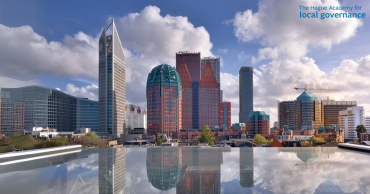
In the at-risk coastal city of The Hague, for example, practitioners have looked for ways to better incorporate climate concerns into the city’s economic supply chain, like designing ocean wind farms that support the growth of commercial and non-commercial fish species at their base. Transformations like these reduce climate stressors while creating new economic opportunities.
Imagining Urban Resilience in Practice
Picture a city where livelihoods are diverse, communities are organised, and services are reliable. Now imagine this city facing a sudden flood or the closure of a major employer. Does it falter, or does it adapt and recover?
“Definitions are useful, but imaginations are more actionable. When you can imagine resilience, it becomes easier to build it.”
– Urban Governance Expert and Trainer Esmeralda Garcia
Practitioners should see resilience as a continuous process that links social, economic, environmental, and institutional dimensions into adaptable strategies. It is a way of aligning efforts in housing, health, environment, and development with the social and economic capacities that keep cities moving forward.
Urban resilience starts with local governance practitioners
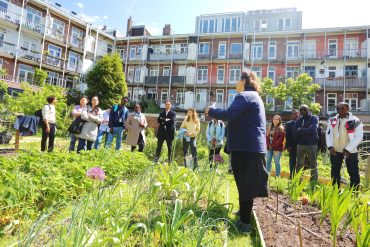
The Hague Academy’s Urban Governance course equips practitioners with practical tools to build urban resilience. Through peer learning, analysing international case studies, and visiting examples in The Netherlands, participants will be supported in designing strategies for urban resilience and plan for the long term.
Explore our open course and customised trainings on Urban Governance: Resilient and Smart Cities.

Related courses
We offer a diversity of courses throughout the year. Here are several other courses you might like.