How to defend democratic values and contribute to democratic resilience.

In Oman, communities in water scarce regions have developed ways to manage water collectively, ensuring that water is treated as a communal resource that is shared fairly and used sustainably. The ‘aflaj’ supply and irrigation systems are networks of underground tunnels that channel water from springs of wells to villages and farms. Visits to these community-managed water systems were part of our Shiraka Water Management Programme and offered valuable lessons to water practitioners from the MENA-region, where access to water is often limited.

Participants of the Shiraka Water Management course with aflaj system managers in Izki, Oman.
Oman’s Local Water Governance in Practice
An aflaj is a network, gently sloping underground channels, that transports water from a spring or well to farms and villages. The aflaj have sustained communities in one of the world’s most water-scarce environments since 500 BC. Built and maintained by farmers, this water management system emerged as a communal response to drought and climate variability.
What makes the aflaj system particularly relevant today is its governance model:
- Farmers can access the water according to precise, time-based systems based on their contributions to the construction and maintenance of the aflaj. This ensures equitable access among users even when water availability fluctuates.
- Locally appointed guardians oversee the distribution of the water, the maintenance of the tunnels, and conflict resolution, while decisions are taken collectively by the community.
- The systems rely on effective cooperation between upstream and downstream users and are guided by shared rules and mutual accountability.
- Knowledge about responsible water management, fair water distribution, and sustainable irrigation for agriculture, is passed down through generations, allowing communities to continuously adapt to changing conditions.
“The visit highlighted the socio-economic importance of Aflaj in Oman, from agriculture productivity to community organisation and long-term water sustainability. A practical and insightful experience connecting engineering, heritage, and real-world water governance.”
— Jana Rammal, Doctoral School of Science of Technology/ Foras Khadra, Lebanon

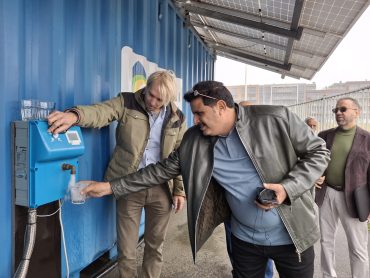
Participants during their visit to the UNESCO Chair on Water Aflaj Studies.
Experiencing Effective Water Management First-Hand in Oman

A visit to the community-managed Aflaj system in Izki and Nizwa, Oman, was a part of the Shiraka Water Management training programme that brings together water professionals from across the MENA region who are involved in shaping and implementing water policies.
For them, the visit was a highlight of the programme. Seeing local guardians oversee water management systems reinforced the importance of trust, clear rules, and community ownership in water management as discussed in various sessions during the training programme.
The Aflaj in Oman demonstrate that effective water governance depends on systems that involve local water users, include traditional knowledge of water variability, climate and agriculture, and coordinate effectively between users and different levels of government.
“The aflaj systems illustrate how water governance works best when rules, responsibilities, and trust are clearly shared between all stakeholders, from communities to institutions. For public officials, seeing this cooperation in practice helps translate governance principles into real-world application, which is why visits like this are a core element of the training programme.”
— Elena Masterova, Programme Manager and Trainer at The Hague Academy
Do you want to learn more about how to involve water users in water resource management? Join The Hague Academy’s Water Governance course to learn from best practices such as the Aflaj system.
Related courses
We offer a diversity of courses throughout the year. Here are several other courses you might like.