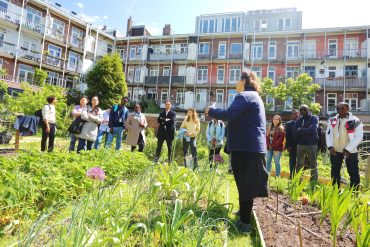
How to build climate resilience and improve local response mechanisms of local authorities.

In rural Pakistan, village development plans bring together residents, local authorities, and NGOs to address poverty and increase climate resilience. The Pakistan Poverty Alleviation Fund manages over a hundred of these initiatives, developing irrigation, drainage and safe drinking water systems, reaching over 136,000 people. To improve effective cooperation with its stakeholders, the fund requested The Hague Academy to design a tailored programme on local climate adaptation.
The main challenge for staff and partners of the fund, was to develop a consistent climate approach in all their programmes. This is especially important in Pakistan, where recurring floods, droughts, heatwaves, and water shortages affect rural communities every year.
“Due to repeated floods, we realised that we need a much stronger understanding of climate response across all our teams and partner organisations. The training showed us that climate adaptation cannot be treated as a separate issue from, for example, infrastructure.” — Asadullah Saleem, Specialist Infrastructure Development
In the training, they discussed how to make climate adaptation a standard part of programme design, budgeting, infrastructure, and community engagement.
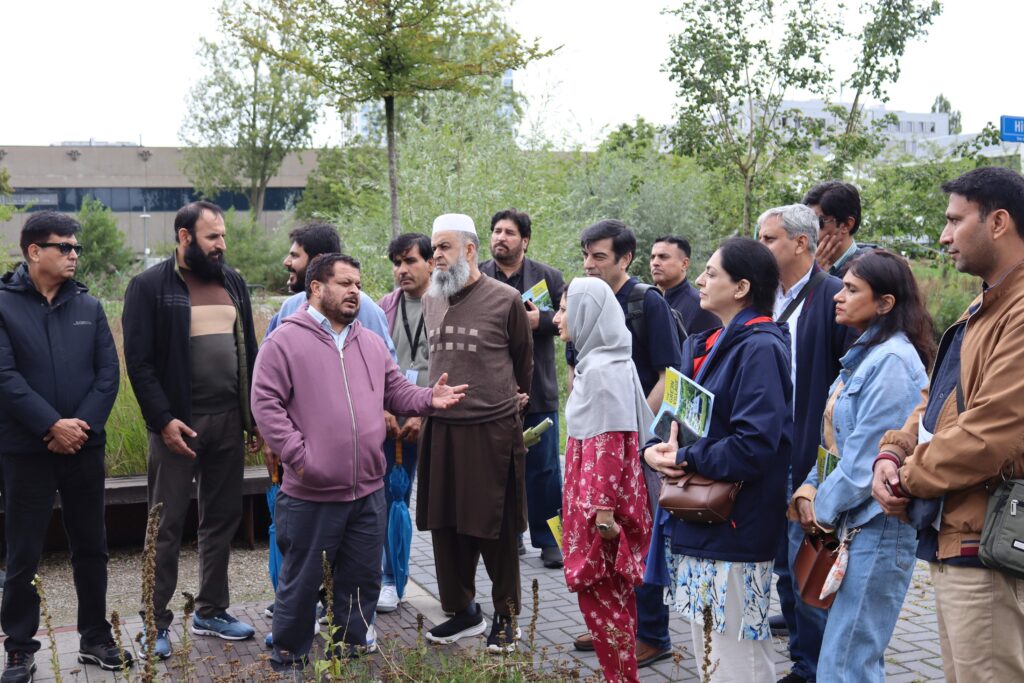
PPAF and its partners discussing innovative climate adaptation measures at the Green Village at Delft University of Technology.
From individual projects to a common approach
The fund and its partners identified that climate considerations are not yet applied consistently across programmes. In their projects, infrastructure, livelihoods, poverty alleviation, and capacity development are often planned separately, even though climate risks affect all of them. Also, communities experience water shortages, crop losses, or damaged infrastructure as separate problems, even when they are linked to the same climate risks. At the same time, national and district governments focus mainly on policy development but do not think about how these policies can be implemented by the local communities.
The participants worked on climate adaptation planning, gender and vulnerability assessments, climate finance, and disaster risk management to further strengthen existing rural development programmes.
They visited The Green Village at Delft University of Technology, where participants saw researchers, businesses, and public institutions test climate solutions together before they are applied at a larger scale. After the visit, a collaboration was initiated between the Green Village team and the Pakistani engineers to continue learning about innovations that the Green Village is testing. During a walking tour of Rotterdam, the participants saw how the city includes water governance as an integral part of urban planning and infrastructure projects.
“Given Pakistan’s fragile climate situation and its social and economic challenges, this course will help us better coordinate climate adaptation and mitigation measures and respond to the needs of rural communities exposed to climate shocks.” — Muhammad Ashraf, Livelihood Expert
Climate mainstreaming requires cooperation
Making climate adaptation part of projects and programmes requires people in organisations to work differently. Climate specialists need to work together with colleagues responsible for infrastructure, livelihoods, and finance. Partner organisations need practical skills to assess climate risks. Governments need to provide reliable data, while communities need channels to share their priorities and their knowledge. Management of the fund support is essential to make this approach part of everyday programme design.
The course supported the fund and its partners through an “action planning” approach, in which they identified several barriers to be addressed: a lack of reliable local data, limited access to climate finance, and difficulties coordinating with public institutions. They also stressed the importance of involving communities directly to connect local knowledge with technical expertise. This will improve both early warning and the design of adaptation measures that communities are more likely to maintain. Furthermore, they expressed the need to build further capacities in their own organisation to better design their programmes with climate action in mind and bring all stakeholders on board.
“We will revisit our ongoing and upcoming investments to identify where climate adaptation can be integrated more systematically. We will also apply the tools we gained with our teams and partner organisations, so that climate considerations become part of how we design and implement programmes.” — Asadullah Saleem, Specialist Infrastructure Development.
Are you also looking to implement climate mitigation and adaptation strategies into your programmes and projects? Learn more about our upcoming Local Climate Responsecourse.
Related courses
We offer a diversity of courses throughout the year. Here are several other courses you might like.